
Social Casinos in the Philippines: The 2026 Guide to Free-to-Play Casino-Style Gaming
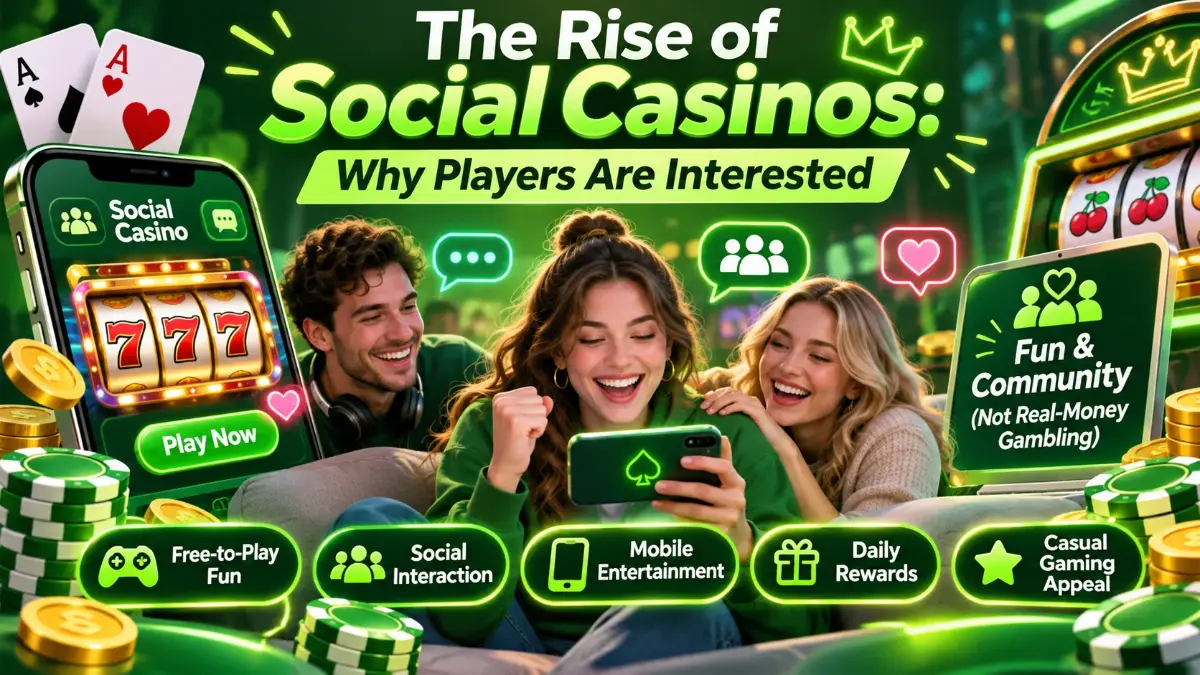
Social casinos have become one of the most talked-about trends in the Philippine iGaming space in 2026, because they let players enjoy casino-style games and slot mechanics without the financial exposure of real-money wagering. Instead of risking cash, players use virtual credits and coins, and the appeal is built on entertainment, social interaction and low-pressure exploration rather than on chasing payouts.
Introduction
Social casinos are free-to-play casino-style platforms that use virtual coins instead of real money, and their rise in the Philippines reflects growing player interest in low-risk entertainment, social features and game discovery. Filipino players are drawn in by no-deposit gameplay, sweepstakes-style mechanics and the chance to learn slot volatility and live dealer formats before ever touching a real-money account. The trade-off is clear: social casinos are entertainment products, not income streams, and they are not a substitute for licensed real-money platforms when actual cash withdrawals matter.
This guide breaks down exactly how social casinos work in 2026, why they've exploded in popularity among Filipino players, what they teach, what they can't teach, and how to transition safely to licensed real-money play if and when you choose to. It's written for players who want straight answers, not hype.
In one sentence: Social casinos are free-to-play casino-style game platforms where players wager virtual coins — not real cash — primarily for entertainment and social competition.
Overview
The Philippine online gambling market has matured quickly. Licensed operators under PAGCOR oversight now operate alongside widespread GCash and Maya adoption, and an entire generation of players first experienced slot mechanics through free social apps before ever opening a real-money account.
That sequence matters. Social casinos have become the de facto on-ramp for millions of players worldwide, and the Philippines is no exception. Players learn the rhythms of slots, the rules of baccarat, and the psychology of a session — all before a single peso is at stake.
But the two product categories are fundamentally different, and confusing them is the single biggest risk in this space.
The practical framing: If you want real cashouts, you need a licensed real-money operator with KYC and withdrawal rules. If you want low-stakes fun, social casinos deliver it — but the two should never be confused.
Entity Summary
The social casino phenomenon in the Philippines sits at the intersection of casual gaming, virtual currency economies and the regulated iGaming ecosystem. Understanding the entities involved helps Filipino players place social casinos correctly in their overall gambling landscape.
| Entity | What it is | Relevance to Filipino players |
|---|---|---|
| Social casino | Free-to-play casino-style platform using virtual coins | Entry point for slot and table game discovery without cash risk |
| Virtual currency | In-app coins or credits used for wagering | Cannot be cashed out at most social casinos (exceptions: sweepstakes models) |
| Sweepstakes casino | Hybrid model with free entry and prize redemption | Legally distinct from real-money gambling; varies by jurisdiction |
| PAGCOR | Philippine Amusement and Gaming Corporation, the regulator | Licenses and oversees real-money online gaming in the Philippines |
| Real-money online casino | Licensed platform accepting PHP deposits and paying withdrawals | The only legitimate route for cash play in the PH market |
| GCash / Maya | Dominant Philippine e-wallets | Primary payment rails for real-money deposits and withdrawals |
| KYC | Know Your Customer identity verification | Mandatory at licensed operators before withdrawal |
| RTP | Return to Player percentage | Same concept applies in social slots, though payouts are virtual |
| Volatility | Variance in game outcomes | Learnable risk profile — social play is a free way to study it |
| Responsible gambling tools | Deposit limits, time-outs, self-exclusion | Essential regardless of whether play is social or real-money |
Key distinction: Social casinos monetise through coin purchases, ads and subscriptions. Licensed real-money casinos monetise through house edge on actual wagers. These are fundamentally different business models, and players should understand which one they're engaging with.
Key Takeaways
- Social casinos are entertainment platforms using virtual coins, not real-money gambling products.
- Filipino players use them mainly for game discovery, slot volatility literacy and social features.
- Virtual outcomes are random and do not predict real-money results.
- Coin purchases should be budgeted as entertainment spend, with a monthly cap.
- Transitioning to real money requires verifying a PAGCOR-licensed operator, reading wagering terms and completing KYC.
- Responsible gambling tools — time limits, spend caps, self-assessment — apply to social play too.
- The house edge always favours the operator in real-money play; no strategy guarantees profit.
The Problem
So what's actually driving the social casino boom — and what's the catch?
The core problem: casino curiosity meets financial fear
Social casinos remove the single biggest barrier to casino curiosity — the fear of losing money. Players can spin slots, try blackjack strategies, and learn baccarat rules with zero peso exposure.
For beginners, this is genuinely valuable: it builds game literacy before real money enters the picture. For experienced players, it's a low-pressure sandbox.
The psychological draw is real but should be named honestly. Fast spin cycles, near-miss animations and escalating reward sounds are engagement mechanics, not skill signals. Social casino design borrows heavily from real-money slot design because it works on the same attention systems.
The hidden problem: the line between entertainment and gambling blur
Because social casinos look, sound and feel exactly like real-money casinos, the boundary between them can erode. A player who spends three hours daily on a social slot app is rehearsing the same behaviour patterns as a real-money player — without the regulatory protections.
That's the tension every Filipino player should understand. Social casinos are safe in the financial sense, but they are not neutral environments.
The problem with sweepstakes-style platforms
Some "social casino" platforms operate sweepstakes-style mechanics, offering free entry with a path to prize redemption. This model is legally distinct from both social casino play and licensed real-money gambling.
In the Philippines, players should be cautious: any platform offering real-value payouts is operating in a space that demands regulatory scrutiny, and unlicensed cash payouts carry real risk.
The Solution
The solution is straightforward: understand what social casinos are designed to do, use them for the legitimate benefits they offer, and keep them strictly separate from real-money play.
Social casinos solve a real problem: they give curious players a zero-cost way to explore casino mechanics, learn volatility, and build bankroll discipline before committing real cash.
They do not solve the cash problem: no amount of virtual play produces real withdrawals. That requires a licensed PAGCOR operator with proper KYC and payment rails.
What social casinos genuinely offer
- Zero-risk experimentation with slots, blackjack, roulette, baccarat and bingo formats.
- Experiential learning of RTP and volatility concepts.
- Social engagement through guilds, chat, leaderboards and challenges.
- Skill rehearsal for table game rules and bankroll management.
- Low-pressure entertainment with no cash downside.
What they don't offer
- Real cash withdrawals (with narrow sweepstakes exceptions).
- Regulatory protection under gambling law.
- Authentic emotional pressure of real stakes.
- Any predictive signal about real-money outcomes.
The balanced verdict: Use social casinos as a learning sandbox and a source of entertainment. Use licensed real-money operators for anything involving real pesos. Never blend the two.
Features
What actually defines a social casino in 2026? These are the features Filipino players encounter most often.
Virtual currency systems
Every social casino runs on an in-app economy — coins, credits, or tokens that fuel play. Currencies are replenished through daily bonuses, timers, ads, tasks and purchases.
Free-to-play entry
No deposits are required to start. New players typically receive a substantial starter balance, and daily login rewards keep the loop running without spending.
Game variety
Social casinos replicate the same core formats Filipino players encounter at licensed sites:
- Video slots: Identical reel structures, payline logic, bonus rounds and volatility profiles.
- Blackjack: Basic strategy applies exactly the same way.
- Roulette: Inside and outside bets behave identically in virtual play.
- Baccarat: Player, banker and tie outcomes follow the same rules.
- Bingo and crash-style games: Popular casual formats adjacent to casino play.
Social and competitive layers
Guilds, friend leaderboards, chat and shared challenges add a genuine social dimension that most real-money slots lack. This is the strongest differentiator against traditional casino apps.
Progression and reward systems
Level systems, XP, daily streaks and battle-pass bundles provide goal structure without wagering pressure. These are the mechanics that keep players returning.
Monetisation features
Coin packs, subscriptions, ad-free upgrades and premium bundles are the operator's revenue sources. Understanding these features helps players control spending.
Benefits
The benefits of social casinos centre on low-risk game discovery, social interaction and beginner education — not on profit.
Benefit 1: Zero-risk game discovery
Beginners can explore dozens of game formats without depositing. A Filipino player can test whether they enjoy high-volatility slots or low-volatility grind sessions, whether baccarat or blackjack suits their temperament, and how long a session realistically lasts — all for free.
Benefit 2: Learning RTP and volatility through experience
Reading about volatility is abstract; feeling a high-variance slot deliver twenty dead spins and then a huge cluster is instructive. Social play teaches this experientially, which is exactly how the concept sticks.
| Volatility | Social play experience | What it teaches for real money |
|---|---|---|
| Low | Frequent small wins, slow coin drain | Longer sessions, smaller swings |
| Medium | Balanced win/loss rhythm | Moderate bankroll requirements |
| High | Long dry spells, rare big hits | Need for larger bankroll and patience |
Benefit 3: Social and competitive features
Guilds, friend leaderboards, chat and shared challenges add a genuine social layer that most real-money slots lack. For players who enjoy gaming as a shared activity rather than a solitary one, this is the strongest draw.
Benefit 4: A safe environment to build bankroll discipline
Players who set a virtual coin budget and stick to it are rehearsing the exact discipline real-money play requires. Session limits, loss limits and stop-win rules can all be practised with zero cost.
This is the most transferable skill social casinos teach. A player who habitually sets a session limit in social play is far more likely to apply the same rule with real pesos.
Benefit 5: Lower pressure and clearer thinking
Without cash on the line, players make clearer decisions. They notice when a game is designed to hook attention, when a bonus round is purely cosmetic, and when they're playing out of boredom rather than enjoyment.
Benefit 6: A realistic filter before real-money play
Social casinos act as a filter. Some players discover they find slots boring after ten minutes — a valuable realisation reached for free. Others discover genuine interest and approach a licensed real-money platform with realistic expectations.
The honest limitation
Social casinos do not build real bankrolls, do not teach pressure management under real financial stakes, and cannot replicate the emotional weight of a real withdrawal or loss. That gap is real and should not be minimised.
Why It Matters
Why should Filipino players care about the social casino trend in 2026?
It's how the next generation enters the market
The Philippine online casino market has matured quickly, with licensed operators under PAGCOR oversight, wider GCash and Maya adoption, and a generation of players who first experienced slot mechanics through free social apps before ever opening a real-money account.
Social casinos are acting as a funnel. Understanding that funnel helps players, regulators and the industry alike.
It exposes the importance of game literacy
Players who've spent time in social casinos generally arrive at real-money platforms knowing the difference between volatility profiles, understanding RTP, and recognising engagement mechanics. That literacy is valuable.
It raises the bar for responsible gambling
Because social casinos can absorb hours of attention without financial cost, the primary risks are time and coin spend. Players who understand these risks early are better positioned to set limits when real money enters the picture.
For context on industry trends
For context on how gambling products are designed to sustain engagement, the American Gaming Association publishes useful industry-level material on gaming trends and consumer protection.
How It Works
Social casino engagement works through a virtual-currency loop: players receive free coins, wager them on familiar casino-style games, earn reward structures like levels and daily bonuses, and can purchase additional coins to continue playing. The games themselves mimic real slot and table mechanics — same symbols, same spin logic, same RTP-style math — but the outcomes settle in virtual credits rather than pesos.
The virtual currency loop, step by step
- Free coin grants: New players receive a starter balance, and daily login rewards replenish it.
- Wagering: Coins are staked on slots, video poker, bingo or table games.
- Reward feedback: Wins return coins, and progression systems award XP, levels and unlockables.
- Coin depletion: Balances run down according to the game's house-edge-style math, even in virtual play.
- Top-up options: Players can watch ads, complete tasks, wait for timers, or purchase coin packs.
The math matters even in virtual currency. Social casino games are calibrated so that coins deplete over time — that's the monetisation engine. Players who notice this pattern understand something real about how house edge works in actual paying casinos.
Where the games meet real-money mechanics
Social casino titles often use the same RTP-style math as real slots. A social slot with a 96% virtual RTP will deplete coins at a rate similar to a real slot returning 96% to players.
That's why social play is genuinely useful for learning how volatility and RTP interact before real money is involved.
For a rigorous explanation of how return to player is calculated, the Wikipedia entry on return to player provides a neutral technical overview.
The monetisation model explained
Social casinos generate revenue from coin purchases, advertising, subscriptions and battle-pass style bundles. None of this involves house edge on real wagers — the operator profits whether you win or lose virtual coins.
That changes the risk profile completely. There's no cash loss, but there is time cost, and spending on coin packs can quietly accumulate. Players should treat coin purchases like any other entertainment spend — budgeted, deliberate and never framed as an "investment" in future winnings.
Who Is It For
Social casinos are not for everyone. The audience is specific.
Who social casinos are for
- Beginners curious about casino games but unwilling to deposit real money yet.
- Returning players who want to refresh table game rules without pressure.
- Social gamers who enjoy guilds, leaderboards and shared challenges.
- Players studying volatility and RTP who want free exposure to different game profiles.
- Casual players seeking short entertainment sessions with zero financial downside.
Who social casinos are not for
- Players seeking real cash withdrawals — those require a PAGCOR-licensed operator.
- Anyone chasing losses from real-money play — social play can normalise chasing behaviour.
- High-stakes players wanting authentic financial pressure and decision-making.
- Underage users — most platforms require 17+ or 18+.
Age and eligibility
App store policies typically require 17+ or 18+, and licensed real-money Philippine online casinos require players to be at least 18, with 21+ applying at some land-based venues.
Use Cases
How do Filipino players actually use social casinos in 2026?
Use case 1: Learning slot volatility
A player who's never tried slots before can spend a week on a social casino experiencing high, medium and low-volatility games. They learn which profile suits their temperament before depositing real money.
Use case 2: Rehearsing blackjack basic strategy
Basic strategy charts are useless if you can't apply them under time pressure. Social blackjack lets players drill the decision tree until it's automatic.
Use case 3: Understanding baccarat commission rules
The banker bet pays 0.95:1 after a 5% commission — a rule that confuses many new players. Social play lets them experience it directly, without real-money stakes.
Use case 4: Building bankroll discipline
Players set a virtual coin budget and session limit — rehearsing the exact discipline real-money play requires.
Use case 5: Social play with friends
Guilds and challenges turn solitary slots into a shared activity. This is a genuine entertainment category that licensed real-money platforms rarely replicate.
Use case 6: Testing the waters before committing
Some players use social casinos to answer the question "do I even enjoy this?" — a question that costs nothing to ask.
Examples
Real-world examples of how social casinos show up in Filipino play:
Example 1: The curious beginner
Maria, 24, from Cebu, has never played casino games but is curious after seeing slot streams on TikTok. She downloads a social casino app, plays 300 virtual spins over a week, and learns that high-volatility slots frustrate her.
She decides real-money slots aren't for her. Total real-money spend: ₱0. Value: high.
Example 2: The strategy learner
Carlo, 32, from Manila, wants to try blackjack at a licensed online casino. He drills basic strategy in a social casino for two weeks, learning when to double, split and stand.
When he moves to a real-money table, he's already fluent. He still loses over time — because the house edge always wins — but he plays correctly and stays within bankroll limits.
Example 3: The social player
Jia, 29, from Davao, plays social casino slots primarily for the guild features. She spends ₱500 monthly on coin packs — budgeted, tracked and treated as entertainment.
She's never tried real-money play and has no interest. For her, social casinos are simply a fun app.
Example 4: The sweepstakes caution
A player encounters a platform advertising "social casino with cash prizes." They investigate, discover no clear licensing, and walk away — the right call. Real-value payouts without regulatory scrutiny are a red flag.
Case Studies
Case study 1: The transferable skill — bankroll discipline
A player who habitually sets a session limit in social play is far more likely to apply the same rule with real pesos. In practice, players who learn unit sizing (1–2% per spin) in a social environment report carrying that habit into real-money sessions with more consistency.
Case study 2: The volatility revelation
High-volatility slots deliver long dry spells punctuated by rare big hits. Experiencing this in a social casino often changes how players approach real-money slots — with larger bankrolls, lower stakes per spin, and less chasing.
Case study 3: The filter effect
Some players discover they find slots boring after ten minutes. That's a valuable realisation reached for free — and it costs the industry nothing, because they were never going to deposit anyway.
Case study 4: The drift case
The most common negative pattern: a player spends hours daily on a social slot app, gradually increases coin purchases to ₱1,500 monthly, and eventually transitions to a real-money platform without reading wagering terms. The drift is subtle, but the pattern is predictable.
Comparison
Social casino vs licensed real-money casino
| Factor | Social casino | Licensed PH real-money casino |
|---|---|---|
| Currency | Virtual coins | PHP |
| Cash withdrawals | Generally none | Yes, after KYC |
| Regulator | App store / consumer law | PAGCOR |
| Deposit methods | In-app purchases | GCash, Maya, bank transfer |
| House edge impact | Virtual coin drain | Real financial risk |
| Age requirement | App store policy (often 18+) | 18+ (21+ at some venues) |
| Best use | Learning, entertainment | Real-money play with discipline |
Social casino vs sweepstakes casino
Sweepstakes platforms offer a free entry route to prize redemption. This is legally distinct from both social casino play and licensed real-money gambling, and rules vary widely by jurisdiction.
Social casino vs demo mode at a licensed casino
Many licensed operators offer free demo modes that use identical math to the real game — arguably the best of both worlds: real game mechanics with real regulatory oversight, but no cash exposure.
Pricing (if applicable)
Social casinos offer free entry, but most monetise in some form. Here's the typical spend landscape in the Philippines:
- Free tier: Starter coins plus daily bonuses — the baseline, no spend required.
- Coin packs: Ranging from small impulse packs to large bundles; frequent offers and time-limited "sales."
- Subscriptions: Monthly VIP passes with daily coin drops and ad removal.
- Battle-pass bundles: Tiered reward progressions tied to spend.
- Ad-supported tiers: Watching ads for coins — free but time-costly.
Budgeting guidance: Treat coin purchases as entertainment spending with a fixed monthly cap, tracked the same way you'd track any discretionary expense, and never as an investment.
Requirements
What do you need to use social casinos in the Philippines?
Baseline requirements
- A smartphone or tablet with reliable internet — most social casinos are mobile-first.
- An app store account (Google Play or Apple App Store) or browser access.
- Age verification per app store policy, typically 17+ or 18+.
- A payment method (for coin purchases) — often via Google Play or App Store billing, sometimes direct card or e-wallet.
- An email or social login for account creation.
For transitioning to real-money play
- Age 18+ (21+ at some land-based venues).
- A valid PAGCOR licence confirmation on the operator's site.
- A supported payment method — GCash, Maya, or bank transfer.
- A valid government ID for KYC verification.
- Bankroll discipline habits learned in social play.
Best Practices
The best practice for social casino play is treating it explicitly as entertainment: set a time and spend budget, understand that coins are not money, and use the experience to build genuine game literacy before any real-money decision.
Practise the same bankroll rules you'd use for real money
Set a virtual bankroll, decide session length in advance, and stop when either limit hits. This rehearses the discipline that matters most.
- Unit sizing: Stake no more than 1–2% of your virtual bankroll per spin, mirroring real-money practice.
- Session caps: Decide a time limit before you start.
- Stop-win discipline: Bank a virtual win by stopping, not by pressing on.
- No chasing: Virtual or not, chasing losses builds a habit that transfers.
Learn the actual rules, not just the animations
Use social play to genuinely learn baccarat commission rules, blackjack basic strategy and roulette payout structures. These are transferable and objective.
Core rules to master before real money:
- Baccarat: Banker bet pays 0.95:1 after 5% commission; banker has the lowest house edge.
- Blackjack: Basic strategy reduces house edge to roughly 0.5% with good rules.
- Roulette: European single-zero wheels (~2.7% house edge) beat American double-zero (~5.26%).
Treat coin purchases as entertainment spend
Budget coin purchases as you would a cinema ticket — a fixed entertainment cost, never an investment. Keep them separate from any money you might one day deposit at a licensed operator.
Verify licensing before transitioning to real money
When curiosity turns to real-money play, switch platforms entirely. Confirm the operator holds a valid PAGCOR licence, check the payment methods (GCash, Maya, bank transfer), review the withdrawal and KYC process, and read the bonus terms — especially wagering requirements.
For guidance on warning signs of unlicensed or predatory operators, the Philippine Competition Commission and consumer protection resources are useful references for how to evaluate online businesses.
Use responsible gambling tools from day one
Time limits, self-imposed spend caps and honest self-assessment apply to social casinos too. If play stops feeling optional, that's the signal regardless of whether real money is involved.
Support resources exist in the Philippines, and problem gambling help lines are available through PAGCOR-affiliated programmes. Responsible gambling is a practice, not a checkbox.
Keep social and real-money play strictly separate
Never use social casino wins as evidence that a real-money strategy "works." They're different products with different economics. Conflating them is the most common cognitive error in this space.
Common Mistakes
Mistake 1: Believing virtual wins predict real outcomes
Social wins are calibrated to a virtual economy, not to a real payout structure. Outcomes at licensed sites are random and the house edge always favours the operator over time.
Mistake 2: Losing track of coin purchase spending
Small, repeated purchases add up quietly. A player buying a few coin packs weekly can spend more than they'd ever deposit at a real-money casino — with no chance of withdrawal.
Fix: Track coin spending monthly and set a hard cap.
Mistake 3: Assuming a social casino is "safer" by default
Social casinos carry no financial wagering risk in the traditional sense, but they carry attention and spending risks. "No real money" does not mean "no risk."
Mistake 4: Confusing sweepstakes mechanics with licensed gambling
Platforms offering real-value prize redemption are operating in a legally complex space. Filipino players should be wary of any platform promising cash-equivalent payouts without clear licensing.
Mistake 5: Skipping the regulatory check before real-money play
The jump from social to real money should trigger a full verification routine: licence check, payment method review, wagering terms, KYC requirements and withdrawal timelines.
Skipping this is how players end up at unlicensed sites with no recourse.
Mistake 6: Ignoring the house edge because "it's only coins"
Even in virtual play, understanding that outcomes are random and house-edge-structured is the core literacy lesson. Players who ignore it in social play tend to ignore it with real money too.
Tips
Tip 1: Use social casinos as a curriculum, not a pastime
Pick specific skills to work on (say, blackjack doubling decisions or baccarat odds recognition) and practise them for a defined period. Aimless spinning teaches you less.
Tip 2: Set a session timer
Notifications and scheduled reminders are easy to set up in every mobile OS. A 30-minute session awareness cue is the simplest intervention in the book.
Tip 3: Track your coin purchases monthly
A simple spreadsheet or notes app keeps total spend visible. Ten pesos three times a week compounds.
Tip 4: Compare virtual RTP to real RTP
Most licensed slots publish their RTP. Compare that number to what you read about the social slot you've been playing — the proximity reveals how much of the mechanic you've actually been learning.
Tip 5: Read the sweepstakes rules carefully
If a platform promises prize redemption, read the terms. If they're not clearly stated or don't reference licensing, walk away.
Tip 6: Pre-plan your transition to real money
Write down the steps you'd take before depositing: verify PAGCOR licence, check GCash/Maya support, review wagering terms, complete KYC. Do this before the impulse to play arrives.
Tip 7: Treat coin packs as consumables
Same category as a pizza — pleasant, ephemeral, not investment. That framing keeps your head straight.
Tools & Resources
A short selection of tools, references and organisations that help Filipino players navigate social and real-money play.
- PAGCOR: The Philippine regulator. Check licence status before any real-money deposit.
- American Gaming Association: Industry-level material on gaming trends and consumer protection.
- Wikipedia — Return to Player: Technical overview of RTP mechanics.
- Philippine Competition Commission: Consumer protection reference for evaluating online businesses.
- App store reviews and rating histories: Useful for spotting the sharp practices on coin-based platforms.
- GCash and Maya: Primary payment rails for real-money deposits at licensed operators.
- Responsible gambling self-assessment tools: Available via PAGCOR-affiliated programmes and international resources.
Key entities: Social casinos are free-to-play casino-style platforms that use virtual coins instead of real money, and they have become a popular entry point for Filipino players to learn slot mechanics and table games before transitioning to licensed real money play. The key entities in this space include PAGCOR, which regulates real money online gambling in the Philippines, and e-wallets GCash and Maya, which serve as the primary payment rails for licensed operators requiring KYC verification. The distinction between social casinos and PAGCOR-licensed real money platforms is critical, as virtual currency cannot typically be cashed out except in sweepstakes-style models.
Frequently Asked Questions
What exactly is a social casino?
A social casino is a casino-style game platform that uses virtual coins instead of real money, offering slots, blackjack, roulette and baccarat formats purely for entertainment, with progression systems and social features replacing real payouts.
Are social casinos legal in the Philippines?
Free-to-play social casinos using virtual coins are generally treated as entertainment apps, not regulated gambling, while real-money online casinos require PAGCOR licensing.
Why are Filipino players interested in social casinos?
Filipino players are drawn by free game discovery, mobile convenience, social features and the chance to learn slot volatility and table game rules without spending pesos, especially given the country's strong mobile gaming culture.
Do social casinos pay out real money in the Philippines?
Standard social casinos pay nothing in cash — coins have no monetary value — and any platform offering real-value payouts without clear licensing should be treated with caution.
Are social casinos regulated by PAGCOR?
PAGCOR licenses real-money online gaming operators; free-to-play social casinos using virtual coins generally fall outside gambling regulation and are governed instead by app store policies and consumer protection law.
Can you win real money on social casinos?
Most social casinos pay nothing in cash, though some sweepstakes-style platforms offer prize redemption under rules that vary widely and warrant caution.
How does RTP apply to social casino slots?
Social slots often mirror real-slot math, so a 96% virtual RTP depletes coins at a similar rate to a real slot returning 96% to players over time, which makes them useful for learning how RTP works.
Why are social casinos so popular right now in 2026?
They combine mobile convenience, social features and zero financial risk — which appeals to players curious about casino games without wanting to deposit money. The Philippine market's mobile-first culture amplifies this.
Do social casino skills transfer to real-money play?
Game rules, basic strategy and bankroll discipline transfer well, but real-money pressure, emotional control and variance under financial stakes do not.
Is a social casino safer than a licensed online casino?
It is safer financially because no cash is wagered, but it still carries attention and spending risks and offers no consumer protection of gambling regulation.
What are the risks of social casino play?
The main risks are unplanned coin purchase spending, attention capture through engagement mechanics, and the false belief that virtual wins predict real-money outcomes.
Can I practise blackjack or baccarat strategy on a social casino?
Yes — blackjack basic strategy and baccarat commission rules behave identically in virtual play, making social casinos a genuinely useful free rehearsal space for table game rules.
How much should I spend on social casino coins?
Treat coin purchases as entertainment spending with a fixed monthly cap, tracked the same way you'd track any discretionary expense, and never as an investment.
What age do I need to be to use social casinos?
App store policies typically require 17+ or 18+, and licensed real-money Philippine online casinos require players to be at least 18, with 21+ applying at some land-based venues.
Is it worth moving from social casinos to real-money play?
Only if you understand that real-money outcomes are random, the house edge always favours the operator, and no strategy guarantees profit — and you're comfortable with bankroll limits and KYC requirements.
What should I check before depositing at a real-money online casino?
Confirm PAGCOR licensing, review deposit and withdrawal methods including GCash and Maya, read bonus wagering requirements in full, and understand the KYC process before any deposit.
How do I switch from social casino play to a real-money casino safely?
Verify a PAGCOR licence, confirm GCash or Maya payment support, read bonus wagering terms and complete KYC before depositing. Treat the switch as a platform change, not a continuation.
Are social casinos a good way to learn bankroll management?
They're a useful starting point for practising session limits and unit sizing, but they can't replicate real financial pressure, which is where genuine bankroll discipline is actually tested.
What responsible gambling tools should Filipino players use?
Deposit limits, session time limits, self-exclusion options and honest self-assessment apply to both social and real-money play, and support resources are available through PAGCOR-affiliated programmes.
How do social casinos make money if they don't take real wagers?
They earn through coin pack purchases, advertising, subscriptions, battle-pass bundles and premium upgrades. The monetisation comes from entertainment spend, not house edge.
Can social casinos become a problem even without real money?
Yes. Hours of daily engagement, escalating coin purchases and the normalisation of chasing behaviour are real risks even without direct financial wagering — which is why session and spend limits matter.
What's the difference between a social casino and a demo mode at a licensed site?
Demo mode uses the identical math to the real-money game at a licensed operator, so it's arguably more educationally accurate. Social casinos are separate products with their own economies and progression systems.
Call to Action
The social casino trend in the Philippines isn't going anywhere in 2026 — and that's fine, as long as players use it correctly.
If you're curious about casino games: use social casinos as a free learning sandbox. Set a time and spend budget, learn RTP and volatility, drill strategy, and treat coin purchases as entertainment spend.
If you're ready for real money: switch platforms entirely. Verify a PAGCOR-licensed operator, confirm GCash or Maya support, read the wagering terms, complete KYC, and set deposit and session limits before your first spin.
If you're uncertain: pause. Social casinos will still be there tomorrow. The most important decision in this entire space is the one you make before you spend — real or virtual.
Play with clear eyes, keep social and real-money play strictly separate, and never treat any casino game — social or licensed — as an income stream.